
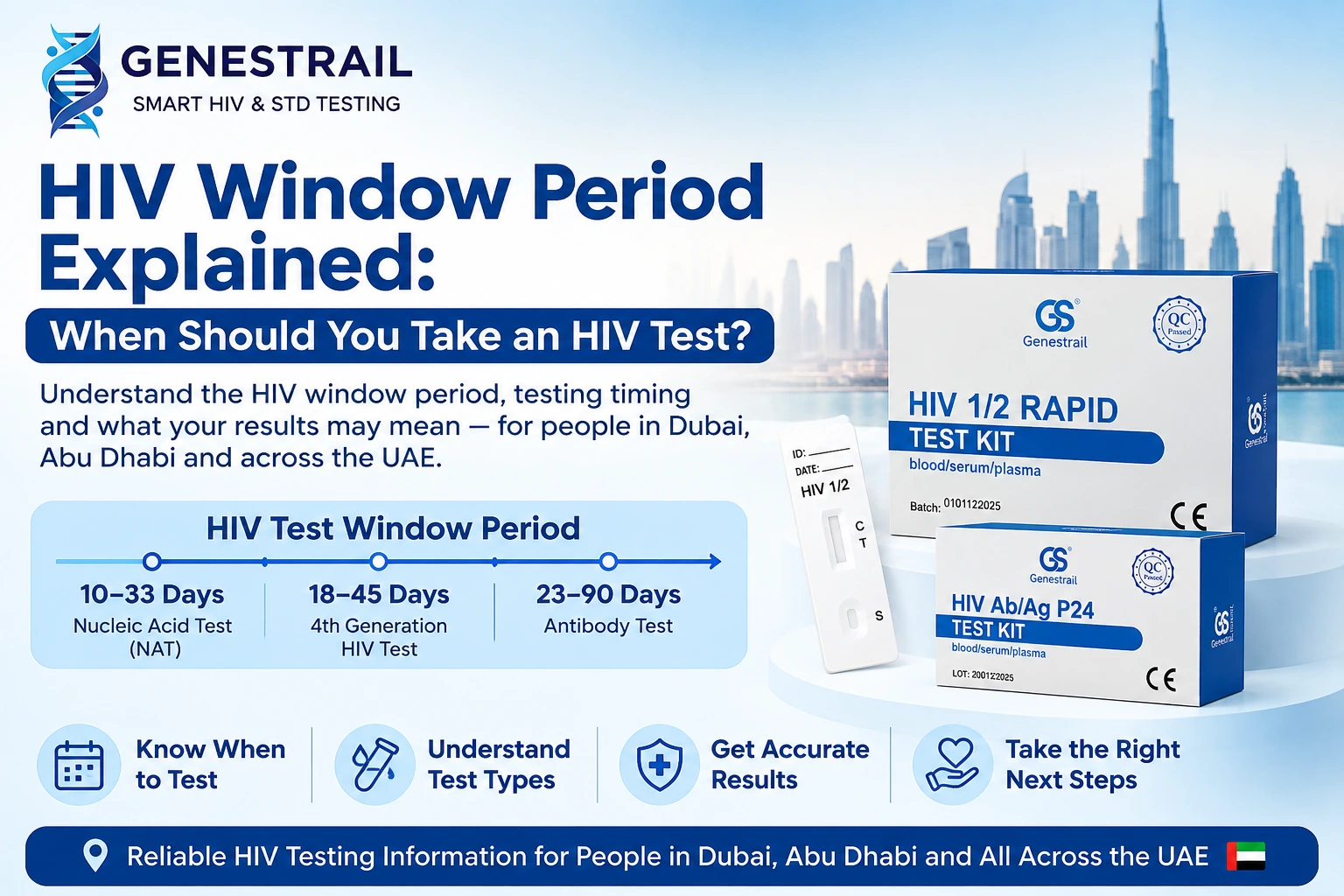
HIV Window Period Explained: When Should You Take an HIV Test?
If you are wondering when to take an HIV test after a possible exposure, the answer depends on the type of HIV test you use and how much time has passed since the exposure.
The period between HIV infection and the point when a particular test can reliably detect it is called the HIV window period. Testing too early can result in a negative result even when infection has occurred.
This guide explains the HIV test window period, the differences between common HIV tests, when an HIV test kit may be useful, and what people in Dubai, Abu Dhabi, Sharjah and other parts of the UAE should know about testing timing.
Important: If a possible HIV exposure occurred within the last 72 hours, do not wait for the window period to pass before seeking medical advice. HIV post-exposure prophylaxis (PEP) should be started as soon as possible and no later than 72 hours after a potential exposure when clinically indicated.
What Is the HIV Window Period?
The HIV window period is the time between HIV infection and when a particular HIV test can detect the infection.
Different tests look for different markers of HIV. Some tests detect antibodies, while antigen/antibody tests look for both antibodies and the p24 antigen.
Because these markers appear at different times, the window period is not identical for every HIV test.
According to the CDC, a laboratory antigen/antibody test using blood from a vein can usually detect HIV approximately 18–45 days after exposure, while an antigen/antibody test using a finger-prick sample may take longer. Antibody tests generally have a longer detection window.
WHO also emphasizes that the window period depends on the test used and that people with a recent suspected exposure may need follow-up testing after an initial negative result.
Why Does HIV Testing Have a Window Period?
HIV tests do not necessarily detect the virus immediately after infection.
Depending on the test, the test may need to detect:
HIV antibodies produced by the immune system
HIV p24 antigen
HIV genetic material using a nucleic acid test
These markers become detectable at different points following infection.
This is why a person can test negative shortly after an exposure and still need further testing later.
Does a Negative Result Always Mean You Do Not Have HIV?
Not necessarily if the test was taken during its window period.
A negative result is interpreted in the context of:
The type of HIV test used
The time since possible exposure
Whether the test was performed correctly
The manufacturer's instructions
Whether there has been another potential exposure
If you have had a recent possible exposure, speak with a qualified healthcare professional about whether repeat testing is appropriate.
HIV Test Window Period by Test Type
There is no single window period that applies to every HIV test.
Laboratory Antigen/Antibody HIV Test
A laboratory antigen/antibody test using blood from a vein can usually detect HIV 18–45 days after exposure, according to the CDC.
These tests detect both HIV antigen and antibodies and are commonly used for laboratory HIV screening.
Finger-Prick Antigen/Antibody Test
Some rapid antigen/antibody tests use a finger-prick blood sample.
The CDC notes that antigen/antibody tests using finger-prick blood can take longer to detect HIV than laboratory tests using blood from a vein, with a stated window of approximately 18–90 days.
The exact detection window should always be checked against the instructions for the specific product.
Antibody HIV Test
Antibody tests detect the immune response to HIV rather than the virus's antigen.
The CDC states that antibody tests can generally detect HIV 23–90 days after infection.
This is why the type of HIV test matters when deciding when to test.
Nucleic Acid Test (NAT)
Nucleic acid tests look for HIV in the blood itself.
According to the CDC, NATs can usually detect HIV approximately 10–33 days after infection.
NAT testing is different from the rapid or self-test kits commonly discussed by consumers, so people should seek professional medical advice if they believe very early testing may be necessary.
What About a 4th Generation HIV Test?
A 4th generation HIV test detects both HIV antibodies and the p24 antigen.
The p24 antigen can appear before antibodies become detectable, which is one reason antigen/antibody testing can identify infection earlier than antibody-only testing in many circumstances.
However, "4th generation" does not mean that every product has exactly the same detection window.
The sample type, testing method and specific product all matter.
If you are considering an HIV test kit 4th generation, always follow the manufacturer's instructions for the specific product.
Genestrail provides a 4th Generation HIV Ag/Ab/P24 Test Kit for people researching HIV testing options.
When Should You Take an HIV Test After Exposure?
There is no single answer that applies to everyone.
The best testing time depends on:
The date of the possible exposure
The type of HIV test
Whether the test uses blood from a vein, finger-prick blood or another sample
Whether you are taking or have recently taken HIV prevention medication
Whether there have been additional exposures
Advice from a healthcare professional
If you test during the window period and receive a negative result, you may need to test again at an appropriate time.
WHO recommends that people with a recent or ongoing risk of exposure receive appropriate follow-up rather than applying the same retesting schedule to everyone.
What If the Possible Exposure Happened Less Than 72 Hours Ago?
This is an important distinction.
If you think you may have been exposed to HIV within the last 72 hours, do not simply wait for an HIV test to become accurate.
PEP is medication used after a possible exposure to reduce the chance of acquiring HIV. CDC guidance states that PEP should be started as soon as possible and no later than 72 hours after exposure when indicated.
Why Is Timing Important for PEP?
PEP is time-sensitive.
If you believe you may have had a significant HIV exposure recently, seek urgent medical evaluation rather than relying on a home HIV test alone.
An HIV test may still be useful as part of medical evaluation, but testing does not replace urgent assessment for PEP when it is indicated.
Can an HIV Test Kit Be Used at Home?
Some HIV self-test kits are designed to allow people to test themselves outside a traditional healthcare setting.
WHO recognizes HIV self-testing as an important additional approach to HIV testing services. However, a reactive self-test result requires appropriate follow-up and confirmatory testing.
If you are considering an HIV test kit in Dubai, an HIV testing kit in Abu Dhabi, or testing options in Sharjah, check the specific product information before testing.
What Should You Check Before Using an HIV Test Kit?
Before using an HIV test kit, check:
Test type
Sample type
Manufacturer instructions
Expiry date
Storage conditions
Required testing procedure
Result interpretation
Stated limitations
Recommended follow-up
Do not choose an HIV test kit based only on its price.
How Does HIV Test Kit Price Relate to Test Type?
People searching for HIV test kit price may find significant differences between products.
Price can vary according to:
Test technology
Manufacturer
Packaging
Sample type
Intended use
Distribution channel
A cheaper test is not necessarily the most appropriate test for a particular situation.
When comparing an HIV test kit, consider the test's intended purpose and detection characteristics rather than price alone.
Can You Buy an HIV Test Kit in Dubai?
People searching for an HIV test kit Dubai or HIV testing kit near me may find different testing options through healthcare providers, laboratories, pharmacies and other suppliers.
Before purchasing a kit, check that:
The product is clearly identified
The instructions are available
The product has not expired
Storage requirements have been followed
The test is appropriate for its intended use
You understand how the result should be interpreted
You can also explore Genestrail for information about HIV and STD testing products.
What About an HIV Test Kit in UAE Pharmacies?
Some people specifically search for an HIV test kit in UAE pharmacy or ask whether they can find a testing kit at a nearby pharmacy.
Availability can vary by pharmacy, location and product.
If you are comparing pharmacy and online options, focus on the quality and suitability of the test rather than simply choosing the most convenient or cheapest product.
For people in Dubai, Abu Dhabi and Sharjah, the same basic testing principle applies: the correct testing time depends on the test used and the time since possible exposure.
HIV Testing in Dubai, Abu Dhabi and Sharjah
The HIV window period is a biological and test-specific issue, so it does not change simply because you live in Dubai, Abu Dhabi or Sharjah.
However, the way people access testing can differ.
HIV Testing in Dubai
People searching for an HIV test kit in Dubai may be looking for privacy, convenience or access to testing without unnecessary delays.
The most important step is to choose an appropriate testing method and follow its instructions.
HIV Testing in Abu Dhabi
People searching for an HIV test kit Abu Dhabi should similarly consider test type, timing, sample collection and follow-up requirements.
A negative result obtained too early may not exclude an infection.
HIV Testing in Sharjah
For people searching for an HIV test kit Sharjah, the same window-period principles apply.
Regardless of location, if there has been a recent possible exposure, appropriate medical guidance can help determine the right testing and follow-up approach.
What Does a Negative HIV Test Result Mean?
A negative result means that the test did not detect the HIV markers it was designed to detect.
But interpretation depends on timing.
Negative Result After Testing Too Early
If you test during the window period, a negative result may not be conclusive.
If there was a recent possible exposure, ask a healthcare professional whether repeat testing is appropriate.
Negative Result After the Appropriate Window
A negative result obtained at the appropriate time and using an appropriate test provides greater confidence.
However, no article can determine the correct testing schedule for every individual situation.
The specific test instructions and professional medical advice should guide interpretation.
What Does a Reactive HIV Test Result Mean?
A reactive HIV screening result should not automatically be treated as a final diagnosis.
WHO explains that a full HIV-positive diagnosis requires confirmation according to an appropriate testing strategy.
If a self-test or rapid screening test is reactive:
Do not panic.
Do not assume the result is a final diagnosis.
Seek appropriate medical care.
Follow the recommended confirmatory testing process.
WHO emphasizes the importance of accurate testing and confirmation to minimize the risk of HIV misdiagnosis.
Common HIV Window Period Questions
How long is the HIV window period?
There is no single window period for all HIV tests. It varies according to the test type and sample. For example, the CDC gives approximately 18–45 days for laboratory antigen/antibody testing using blood from a vein, while antibody tests may take 23–90 days to detect HIV.
Can I take an HIV test after one week?
A test may be able to detect HIV in some circumstances at an early stage, but a negative result one week after exposure cannot generally be treated as conclusive for all test types. Testing strategy should be based on the specific test and exposure circumstances.
Is a 4th generation HIV test faster?
A 4th generation test detects both antigen and antibodies and can generally detect HIV earlier than some antibody-only tests. However, the exact detection window depends on the test and sample type.
Should I test again after a negative result?
If you had a recent possible exposure and tested during a relevant window period, repeat testing may be appropriate. WHO recommends retesting based on recent or ongoing exposure rather than automatically requiring everyone with a negative result to repeat testing.
Can an HIV self-test confirm HIV?
A self-test can be useful for screening, but a reactive result requires appropriate confirmatory testing. WHO recommends confirmation of HIV-positive diagnoses through an appropriate testing strategy.
Does HIV test timing change in Dubai or Abu Dhabi?
No. The biological window period is related to HIV infection and the test used, not the city where you live. The same principles apply in Dubai, Abu Dhabi, Sharjah and other parts of the UAE.
Does HIV test kit price determine accuracy?
No. Price alone should not be used to determine whether an HIV test is appropriate. Consider the test technology, intended use, manufacturer information, instructions and quality documentation.
The Key Takeaway About the HIV Window Period
The most important thing to remember is that there is no universal HIV window period that applies to every test.
A test may be able to detect HIV at different times depending on whether it detects antibodies, antigen and antibodies, or viral genetic material.
If you are looking for an HIV test in Dubai, Abu Dhabi, Sharjah or elsewhere in the UAE, consider:
How long ago the possible exposure occurred
Which HIV test you are using
The manufacturer's stated detection window
Whether repeat testing may be appropriate
Whether you need urgent medical assessment
If the possible exposure occurred within the last 72 hours, seek urgent medical advice about PEP rather than waiting for the testing window.
For general information about HIV and STD testing options, visit Genestrail.
Further Reading
You can also read our related guide:
HIV Testing in Dubai & UAE: Complete Guide to HIV Tests, Timing & Results
For people specifically researching home testing in Dubai, see:
Where to Buy an HIV Test Kit in Dubai: Your Complete Guide to Private Home Testing
Medical Information Notice
This article is intended for general educational purposes and does not replace individual medical advice, diagnosis or treatment.
HIV testing decisions should be based on the specific test being used, the timing of possible exposure and individual circumstances. Always read the manufacturer's instructions for the specific HIV test and seek advice from a qualified healthcare professional when appropriate.
Sources
World Health Organization — HIV and AIDS.
World Health Organization — Consolidated Guidelines on HIV Testing Services.
World Health Organization — Preventing HIV Misdiagnosis.
Centers for Disease Control and Prevention — HIV Testing and Window Periods.
Centers for Disease Control and Prevention — PEP Guidance.
