
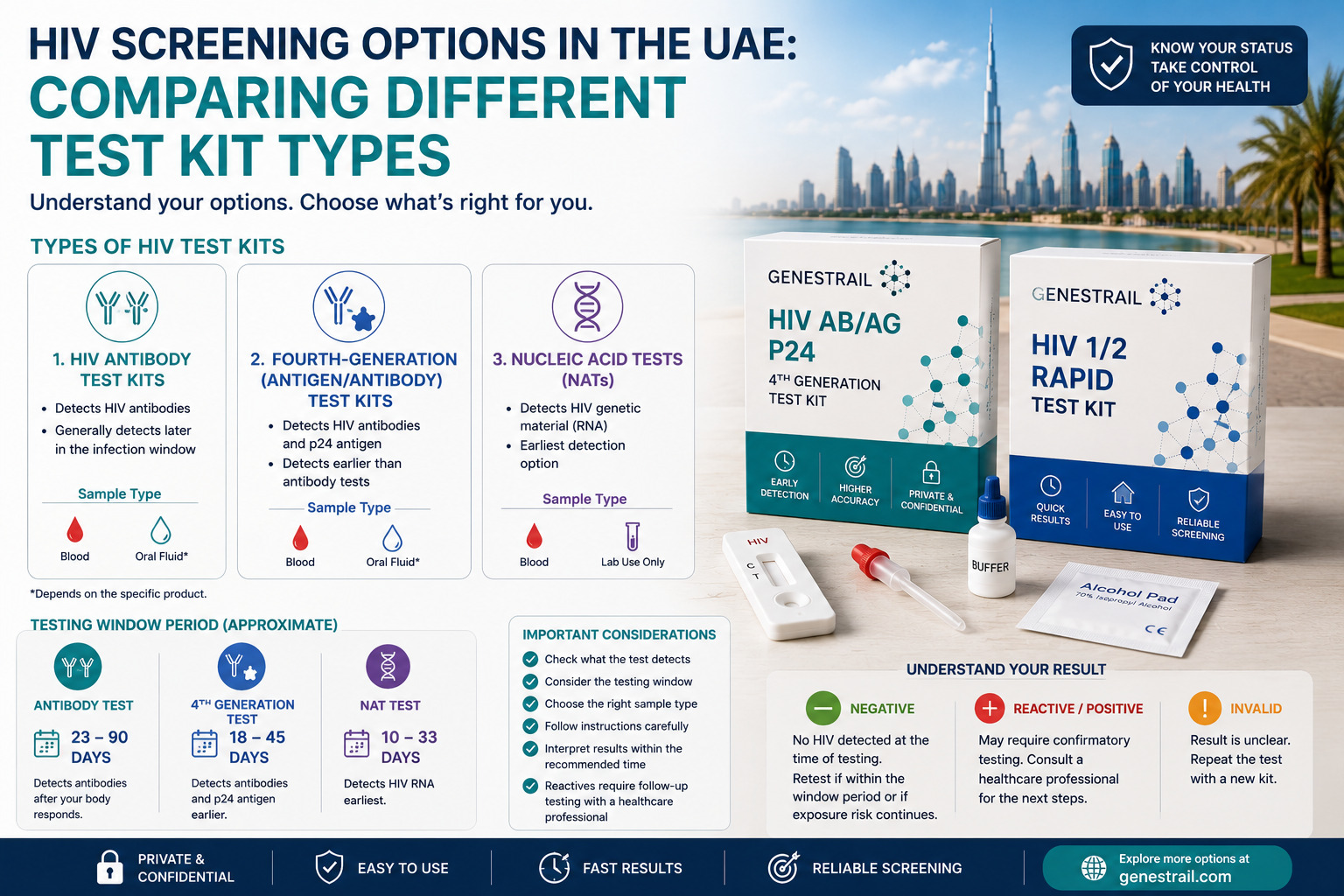
Choosing an HIV screening option can be confusing when different test kits use different testing methods, sample types, and detection technologies. For people in the UAE researching HIV test kits, understanding these differences can make it easier to compare available options and choose a product that matches their requirements.
HIV tests can generally be categorized by what they detect: antibodies, both antibodies and antigen, or viral genetic material. The testing format can also vary, including laboratory testing, rapid testing, and certain self-testing options.
This guide explains the main HIV screening options and what to consider before selecting a test kit in the UAE.
What Is HIV Screening?
HIV screening is testing performed to determine whether a sample contains markers associated with HIV.
The major HIV testing approaches include:
- Antibody tests
- Antigen/antibody combination tests
- Nucleic acid tests (NATs)
The FDA describes these as three major categories used for HIV screening and diagnosis. Antibody tests look for antibodies produced by the immune system, combination tests detect antibodies and antigens, and NATs look for HIV genetic material.
The right testing approach depends on factors such as the purpose of testing, the time since a possible exposure, the sample type, and whether testing is being performed at home or through a healthcare provider.
1. HIV Antibody Test Kits
Antibody tests are designed to detect antibodies produced by the immune system in response to HIV.
These tests can use different sample types depending on the specific product. Some self-tests, for example, use oral fluid, while other products use blood samples.
An antibody-based test may be considered when someone is looking for a straightforward HIV screening option.
However, antibodies take time to develop to detectable levels. This is why understanding the window period is important when interpreting a negative result.
GenesTrail HIV 1/2 Rapid Test Kit
GenesTrail provides an HIV 1/2 Rapid Test Kit for customers exploring HIV screening options in the UAE.
View the GenesTrail HIV 1/2 Rapid Test Kit
Before purchasing, review the product information carefully to understand its intended use, sample requirements, instructions, and limitations.
2. Fourth-Generation HIV Test Kits
Fourth-generation HIV tests use a combination approach.
Rather than looking only for antibodies, they are designed to detect:
- HIV antibodies
- HIV p24 antigen
The p24 antigen is associated with HIV and can become detectable earlier than antibodies. This is one reason combination antigen/antibody testing is an important HIV screening approach.
GenesTrail HIV Ab/Ag p24 4th Generation Test Kit
GenesTrail offers an HIV Ab/Ag p24 4th Generation Test Kit.
View the GenesTrail HIV Ab/Ag p24 4th Generation Test Kit
When comparing fourth-generation products, check the specific product documentation rather than assuming every product labelled "4th generation" has identical characteristics.
3. Nucleic Acid Tests (NATs)
Nucleic acid tests are different from antibody and antigen/antibody tests.
Instead of detecting the body's antibodies or a viral antigen, NATs look for HIV genetic material in the blood. According to the CDC, NATs can detect HIV earlier than antibody and antigen/antibody testing and may be particularly useful in certain circumstances, such as a recent possible exposure.
NATs are generally associated with laboratory or clinical testing rather than the typical consumer home rapid-test format.
If you believe you may have had a recent exposure, a healthcare professional can help determine which testing approach is appropriate.
Rapid HIV Tests vs. Laboratory Testing
Another important distinction is where and how the test is performed.
Rapid Testing
Rapid tests are designed to provide results relatively quickly.
Depending on the specific product, rapid testing can use different sample types and testing technologies.
Some authorized HIV self-tests use oral fluid, while other approved self-test products use fingerstick whole blood.
Laboratory Testing
Laboratory testing can involve a sample collected at a clinic or healthcare facility and analyzed using laboratory equipment.
Laboratory-based antigen/antibody testing using blood from a vein generally has a different detection window from some fingerstick or antibody-only tests.
For people who want the most appropriate test for a particular situation, professional healthcare advice can be valuable.
Understanding the HIV Testing Window Period
The window period is the time between infection and when a particular test can reliably detect the relevant marker.
The window period varies according to the testing method.
According to the CDC:
- Antibody tests may detect HIV approximately 23–90 days after infection.
- Laboratory antigen/antibody tests using blood from a vein can generally detect HIV approximately 18–45 days after exposure.
- Fingerstick antigen/antibody tests can take longer, with a window of approximately 18–90 days.
- NATs can generally detect HIV approximately 10–33 days after infection.
These are general ranges, not a guarantee for an individual test or person. Always follow the instructions supplied with the specific product.
If a negative result occurs during a potential window period, additional testing may be recommended depending on the circumstances.
Blood-Based vs. Oral-Fluid Testing
Sample type is another factor to consider when comparing HIV screening products.
Blood-Based Tests
Blood-based testing may use:
- Fingerstick whole blood
- Blood collected from a vein
- Serum or plasma in laboratory settings
Different blood-based tests can use different technologies.
For example, the FDA lists both antibody tests and antigen/antibody tests using blood specimens.
Oral-Fluid Tests
Some HIV self-tests use oral fluid collected from the mouth.
For example, the FDA-authorized OraQuick HIV Self-Test detects HIV-1 and HIV-2 antibodies in oral fluid.
The sample type can affect the testing window and procedure, so it should always be considered when comparing products.
How to Choose an HIV Test Kit in the UAE
If you are comparing HIV test kits in the UAE, consider the following factors.
1. What Does the Test Detect?
Check whether the product detects:
- HIV antibodies
- HIV p24 antigen plus antibodies
- HIV genetic material
Understanding the detection method is one of the most important parts of choosing a test.
2. What Sample Does It Require?
Check whether the test requires:
- Fingerstick blood
- Other blood samples
- Oral fluid
- Another specimen type
Never substitute a different sample type unless the manufacturer's instructions specifically allow it.
3. What Is the Intended Use?
Read the product description and instructions carefully.
Confirm whether the product is intended for home use, rapid screening, laboratory testing, or another purpose.
4. What Is the Testing Window?
Consider how much time has passed since the situation you are concerned about.
Different tests have different detection windows, so a test that is appropriate at one point in time may not be the most appropriate choice at another.
5. How Are Results Interpreted?
Check the manufacturer's instructions for:
- Result indicators
- Reading time
- Invalid results
- Limitations
- Recommended follow-up
Do not interpret a result outside the specified reading period.
What Does a Negative HIV Test Result Mean?
A negative result means the test did not detect the relevant marker at the detectable level at the time the test was performed.
However, a negative result during a window period may not rule out a recent infection. The CDC recommends considering the timing of testing when interpreting results.
If you believe you may have had a recent exposure, speak with a qualified healthcare professional about whether additional testing is appropriate.
What Does a Reactive or Positive Result Mean?
A reactive or positive screening result should be taken seriously, but the appropriate follow-up depends on the type of test.
For HIV self-tests, a reactive result generally requires follow-up testing to establish the diagnosis. The CDC specifically recommends follow-up testing after a positive self-test.
Do not make a medical diagnosis based solely on an at-home screening result.
Instead, follow the manufacturer's instructions and seek professional healthcare advice.
What If the Test Result Is Invalid?
An invalid result means the test did not produce an interpretable result according to the product's instructions.
Possible reasons can include an issue with the sample or testing procedure.
If a test is invalid:
- Do not interpret it as positive or negative.
- Review the manufacturer's instructions.
- Follow the recommended procedure for repeat testing.
- Contact the appropriate product support or healthcare professional if necessary.
Why Product Instructions Matter
Even when a test is designed for home use, correct procedure is essential.
Before using an HIV test kit:
- Check the expiry date.
- Check the packaging.
- Read the instructions completely.
- Prepare the required materials.
- Use the specified sample.
- Follow the testing procedure carefully.
- Observe the recommended reading time.
The FDA recommends carefully following home-test instructions and seeking healthcare advice when results are concerning or when professional evaluation is needed.
HIV Screening Options from GenesTrail
GenesTrail offers different HIV screening products for customers exploring testing options in the UAE.
HIV Ab/Ag p24 4th Generation Test Kit
This product uses the combination antigen/antibody approach described above.
GenesTrail HIV Ab/Ag p24 4th Generation Test Kit
HIV 1/2 Rapid Test Kit
GenesTrail also offers an HIV 1/2 rapid testing product.
GenesTrail HIV 1/2 Rapid Test Kit
These products have different names and testing approaches, so customers should review the individual product information before choosing between them.
Why Testing Method Matters More Than Just the Product Name
When searching online for an HIV test kit in Dubai or the UAE, it can be tempting to focus on terms such as "rapid," "home," or "4th generation."
However, these terms alone do not tell you everything about a product.
A better comparison includes:
FactorWhat to Check
Detection method
Antibody, antigen/antibody, or NAT
Sample
Blood, oral fluid, or another specimen
Intended use
Home, rapid, laboratory, etc.
Timing
Applicable window period
Instructions
Sample collection and testing steps
Result
How and when to read it
Follow-up
What to do with reactive or unclear results
This approach makes it easier to compare products based on their actual characteristics.
Frequently Asked Questions
What are the main types of HIV tests?
The main categories are antibody tests, antigen/antibody combination tests, and nucleic acid tests.
What is a fourth-generation HIV test?
A fourth-generation test is an antigen/antibody combination test designed to detect HIV antibodies and the p24 antigen.
Is a rapid HIV test the same as a fourth-generation test?
Not necessarily. "Rapid" describes the testing format or speed, while "fourth-generation" describes what markers the test is designed to detect. A specific product's documentation should be checked to determine its testing method.
How soon can HIV be detected?
The detection window depends on the test. NATs can generally detect HIV earlier than antibody-only tests, while laboratory antigen/antibody tests have a different window from fingerstick or antibody tests.
Can a home HIV test replace professional testing?
Home testing can provide a convenient screening option, but it does not replace appropriate healthcare. A reactive self-test generally requires follow-up testing, and people with concerns about recent exposure should discuss testing with a healthcare professional.
Which HIV test kit should I choose in the UAE?
The appropriate option depends on your testing requirements, the time since a possible exposure, the sample type, and the test's intended use. Review the specific product information and consider professional guidance when needed.
Final Thoughts
There are several HIV screening options in the UAE, ranging from antibody tests to fourth-generation antigen/antibody tests and laboratory-based NATs. Understanding how these approaches differ can help you make a more informed choice.
When comparing products, look beyond the product name and consider the detection method, sample type, testing window, intended use, instructions, and follow-up requirements.
GenesTrail provides both an HIV 1/2 Rapid Test Kit and an HIV Ab/Ag p24 4th Generation Test Kit, allowing customers to review different testing approaches according to their requirements.
For any reactive result, unclear result, or concern about recent exposure, professional healthcare guidance is an important next step.
